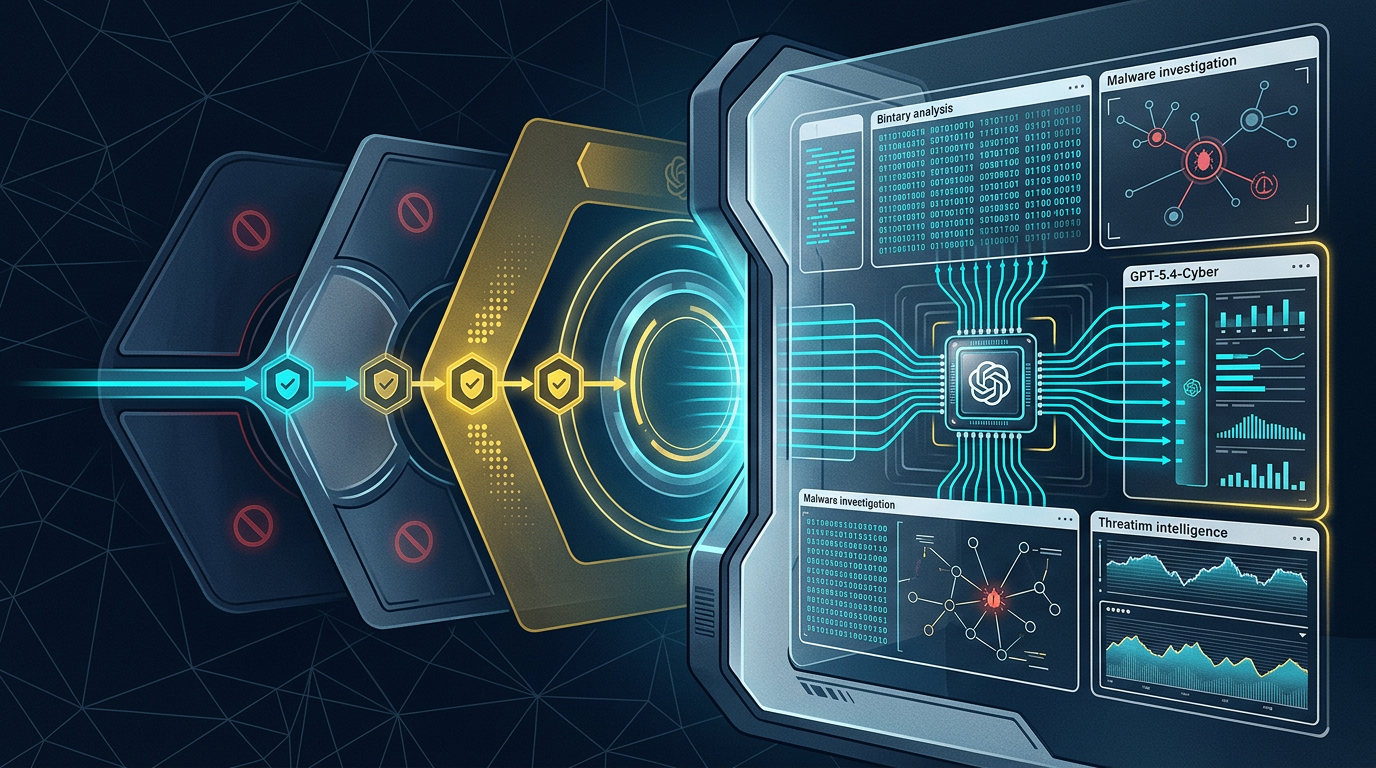



OpenAI is widening the funnel for defensive cybersecurity access just as its frontier models become more capable. The company says it is expanding its Trusted Access for Cyber program to thousands of verified defenders and hundreds of security teams, while introducing GPT-5.4-Cyber, a fine-tuned variant of GPT-5.4 with fewer restrictions for legitimate cyber defense work.
That makes this more than a model launch. It is a policy and deployment story about how OpenAI plans to handle dual-use cyber capability as agentic systems become stronger at code analysis, vulnerability research, and operational security tasks.
A More Permissive Model for Defensive Work
The central change is the introduction of GPT-5.4-Cyber, which OpenAI describes as a cyber-permissive model built for advanced defensive workflows. The company says the model is designed to lower refusal boundaries for legitimate security work and support tasks such as malware analysis and binary reverse engineering, allowing defenders to inspect compiled software even when source code is not available.
That is a meaningful line to cross. Binary reverse engineering is one of the clearest examples of a capability that is valuable for defenders and potentially dangerous in the wrong hands. OpenAI’s answer is not broad public release, but a tiered access model grounded in identity verification, trust signals, and closer scrutiny of who is using the system and for what purpose.
OpenAI Is Pairing Capability Growth With Access Controls
OpenAI frames the move around three principles: democratized access, iterative deployment, and ecosystem resilience. In practice, that means the company wants to make advanced defensive tooling available to legitimate users without treating all cyber-related usage as inherently suspicious, while still restricting the most permissive capabilities behind stronger verification.
The expansion builds on a longer arc. OpenAI points to its Preparedness Framework, prior cyber-specific safeguards, and the rollout of Codex Security as parts of the same strategy. The through-line is clear: model capability in cyber tasks is increasing, and OpenAI wants its safety systems and defender-facing products to scale alongside that curve rather than lag behind it.
That context matters because the company is no longer talking only about blocking malicious use. It is also talking about deliberately accelerating legitimate defenders. Earlier, we covered OpenAI’s Safety Bug Bounty launch, which similarly tried to create structured pathways for trusted security research rather than forcing every sensitive use case into a generic safety bucket.
Why This Matters for Enterprise Security Teams
For enterprise security teams, the immediate significance is practical. OpenAI is signaling that future defensive AI access may increasingly depend on who the user is, how strongly that user can be verified, and whether OpenAI has enough visibility into the operating environment to feel comfortable lowering safeguards.
That is especially relevant for organizations using third-party platforms or zero-data-retention environments, where OpenAI says visibility is lower and therefore restrictions may remain tighter. In other words, access to the most capable cyber tooling may become inseparable from trust architecture, identity checks, and deployment context.
This also nudges the market toward a more mature definition of AI security. The conversation is shifting away from whether AI can help in cyber at all and toward how those capabilities should be governed, audited, and deployed responsibly. That is the same broader question running through our recent coverage of AI security best practices and indirect prompt injection controls.
The Bigger Bet Behind GPT-5.4-Cyber
The deeper strategic bet is that cyber defense should scale in lockstep with frontier model capability. OpenAI is effectively saying the industry cannot wait for some future threshold before building access pathways, safeguards, and trust systems for high-sensitivity defensive use.
That view will appeal to security teams that already feel behind the curve. Attackers are experimenting with AI now, software supply chains remain chronically exposed, and defenders are under pressure to investigate and patch faster across increasingly complex environments. If OpenAI can widen access to more capable defensive models without letting misuse scale with it, GPT-5.4-Cyber could become a template for how frontier labs handle cyber-capable systems going forward.
Comments
No comments yet. Be the first to share your thoughts.
Sign in or create an account to leave a comment.