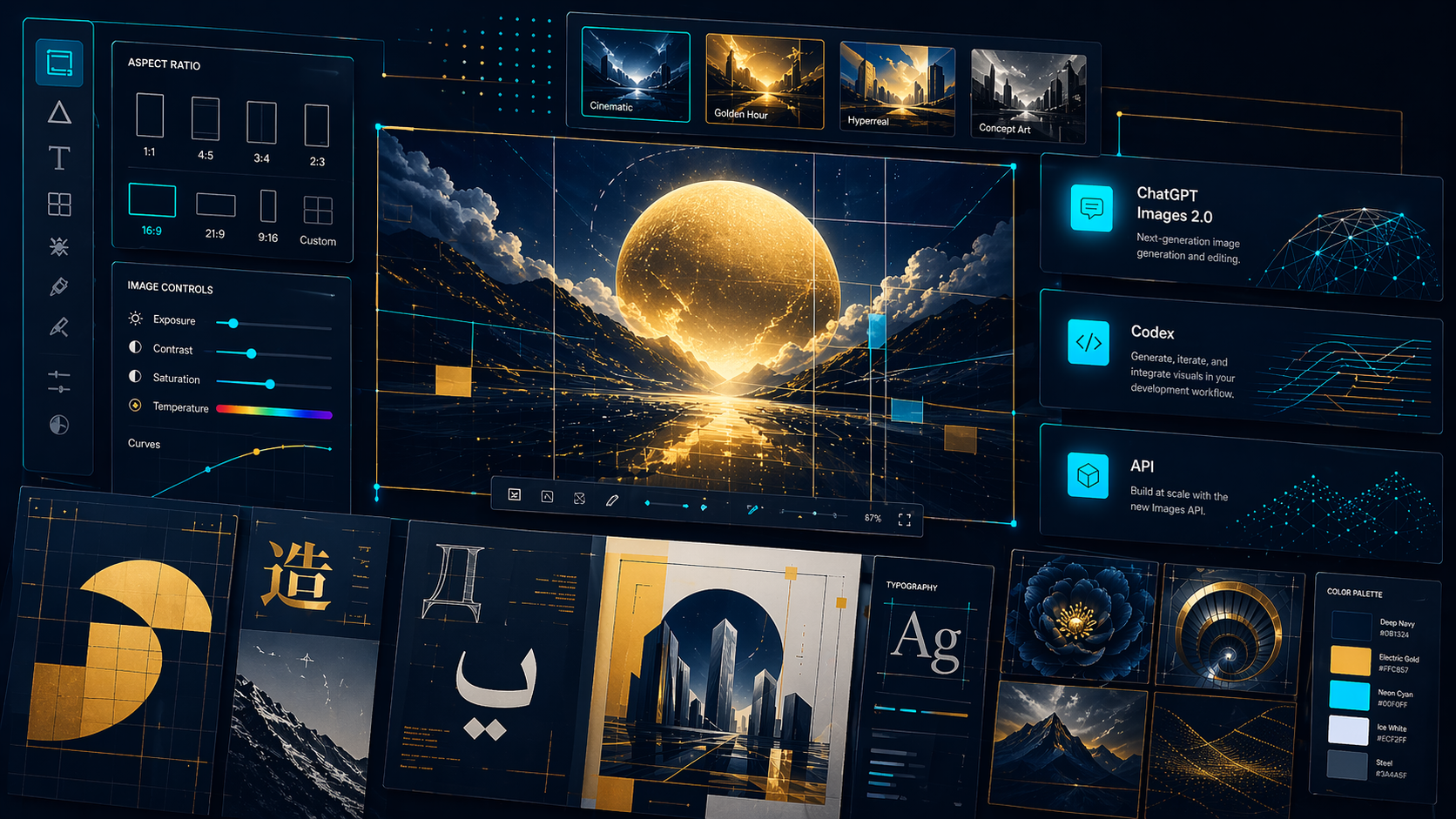



OpenAI is trying to reposition image generation inside ChatGPT from a flashy side feature into something closer to a full visual production system. With the launch of ChatGPT Images 2.0, the company is emphasizing not just prettier outputs, but stronger instruction following, more reliable text rendering, broader language support, flexible aspect ratios, and tighter integration with reasoning-heavy workflows across ChatGPT, Codex, and the API.
That framing matters. The image generation market is now crowded with tools that can produce attractive results from short prompts. OpenAI’s pitch is that the next competitive frontier is not simply aesthetics. It is whether an image model can function as a dependable work tool for explainers, marketing assets, diagrams, product mockups, educational materials, comics, and multilingual visuals that need to be used rather than merely admired.
OpenAI Wants Image Generation to Feel More Like Design Infrastructure
The core message in OpenAI’s launch materials is that images should be treated as a language. In practice, that means the model is being sold less as an artist-on-demand and more as a system that can organize information visually, preserve detailed instructions, and produce outputs that already look like they belong inside real workflows.
According to the company, Images 2.0 improves on the exact failure modes that have historically made image models difficult to trust in production: dense text, small interface elements, object placement, multi-step layout constraints, subtle style control, and unusual aspect ratios. Those are not glamorous benchmark categories, but they are the categories that determine whether a team can turn a generated image directly into a deck, a landing page, a lesson, or a prototype without hours of cleanup afterward.
The broader strategic point is that OpenAI is blending image generation with the reasoning stack it has spent the last year strengthening elsewhere. When a thinking or pro model is selected in ChatGPT, Images 2.0 can search the web for up-to-date information, generate multiple distinct outputs from one prompt, and check its own work more carefully. That pushes the product away from one-shot rendering and toward a more agentic design workflow.
Precision Is the Real Upgrade, Not Just Style
OpenAI’s claim that Images 2.0 represents a “step change” rests heavily on control. The company says the model is substantially better at taking dense instructions and translating them into coherent layouts with accurate object relationships, readable text, iconography, and detailed visual hierarchy. That may sound incremental, but in image generation it is one of the most commercially important shifts possible.
The difference between a model that makes attractive pictures and one that follows layout direction is the difference between toy and tool. If a user can ask for a poster with exact copy blocks, a product explainer with labeled sections, or a UI concept with deliberate spacing and get something structurally useful back, then the model starts to operate inside professional design and communication workflows rather than next to them.
The examples OpenAI highlights reinforce that point. Rather than focusing only on cinematic portraits or dreamy landscapes, the company repeatedly shows outputs that look like editorial spreads, educational explainers, dense infographics, classroom diagrams, and commercial marketing assets. Those are all harder categories because they require the model to organize information, not just render mood.
Multilingual Text Rendering Is a More Important Shift Than It Looks
One of the clearest practical upgrades in the launch is language coverage. OpenAI says prior image models were significantly more reliable in English and other Latin-script languages than they were in dense, complex, or non-Latin text. Images 2.0 is being positioned as a direct answer to that weakness, with gains in Japanese, Korean, Chinese, Hindi, Bengali, and other languages where text inside images often breaks down quickly.
That matters far beyond simple translation. A model that can render multilingual text coherently expands the category of image generation from “creative illustration” into global communication infrastructure. It means a team can think about localizing explainers, educational materials, product posters, comic pages, and branded collateral without assuming that non-English output will need to be rebuilt manually.
In a broader market sense, it also corrects one of the most quietly limiting biases in generative imaging. If English-first outputs are much more dependable than everything else, then the product is effectively strongest for one user class and weaker for many others. OpenAI is clearly trying to remove that ceiling and make the image stack feel more globally native.
Styles, Formats, and Aspect Ratios Push It Closer to a Generalist Visual Tool
OpenAI is also stressing breadth. Images 2.0 is described as stronger across photography, manga, pixel art, cinematic stills, editorial posters, realistic imperfections, and polished commercial design. Support for aspect ratios ranging from 3:1 to 1:3 extends that versatility into more practical output targets, from banners and slide headers to bookmarks, posters, and mobile-first social graphics.
The important shift here is not simply that the model can imitate more styles. It is that OpenAI wants style control, formatting flexibility, and content structure to work together. A model that can mimic a look but fails on layout is still limited. A model that can preserve a visual language while adapting the output to multiple dimensions becomes much more useful for marketing teams, product teams, publishers, and educators who need one concept to travel across surfaces.
That same logic also helps explain why Codex is part of the launch story. OpenAI says users can now create images inside Codex without a separate API key, suggesting that the company sees image generation not as a detached creative module but as a building block that belongs inside app creation, website iteration, deck building, and broader product-development flows.
Reasoning, Codex, and the API Make This a Platform Story
One of the most consequential parts of the launch is not visual at all. It is architectural. OpenAI says Images 2.0 is its first image model with thinking capabilities, which means that when paired with the right ChatGPT model it can search the web, evaluate real-time context, produce multiple distinct outputs from a single prompt, and reason more deliberately through what the final image should contain.
That changes the category from generation to workflow assistance. Instead of asking for one image and manually stitching together a broader project, a user can ask for a set of social graphics, a run of manga pages, or multiple room redesign directions with stronger continuity and less orchestration overhead. OpenAI is effectively arguing that image generation becomes much more valuable when it can participate in planning, structure, and iteration rather than only in rendering.
That same logic extends into Codex and the API. OpenAI says image generation is now available in Codex for people building apps, websites, slide decks, and other work products in one workspace, while developers can access the same underlying capability through gpt-image-2 in the API. That makes this less of a single model release and more of a cross-surface product move. OpenAI wants image generation to live wherever people already build, whether that is inside ChatGPT chats, coding workflows, or third-party software.
The Safety and Business Story Is Just as Important as the Creative Story
OpenAI is also making a familiar but necessary point about limits. The company says Images 2.0 still struggles with tasks that require a complete physical world model, such as origami guides, Rubik’s Cube-style puzzles, hidden or reversed surfaces, extremely dense repeated textures, and diagrams that demand perfect arrow placement or part labeling. That caveat is easy to skim past, but it matters because many of the most commercially interesting use cases involve precision rather than atmosphere.
The company is also pitching the model as safe by design, pointing users toward its ChatGPT Images 2.0 deployment safety page. That positioning fits the broader pattern in generative media launches right now: vendors need to sell not only capability, but credibility. For enterprise buyers especially, the question is no longer whether the model can make a compelling image. It is whether the model can do so consistently, with safeguards, and in a way that fits professional review processes.
Commercially, OpenAI is being deliberate about distribution. The product is available now across ChatGPT and Codex, with advanced outputs tied to higher-tier plans, while gpt-image-2 is offered through the API with pricing dependent on output quality and resolution, as outlined on OpenAI’s pricing page. That gives OpenAI a three-layer strategy: direct consumer use inside ChatGPT, workflow use inside Codex, and product integration through the API.
The larger implication is that OpenAI is not launching a standalone image model so much as expanding the role of visual generation across its entire stack. If the quality and reliability hold up, ChatGPT Images 2.0 could matter less as a single release and more as a sign that OpenAI wants image creation to become a standard capability inside every layer of its platform, from casual prompting to software development to enterprise deployment.
Comments
No comments yet. Be the first to share your thoughts.
Sign in or create an account to leave a comment.