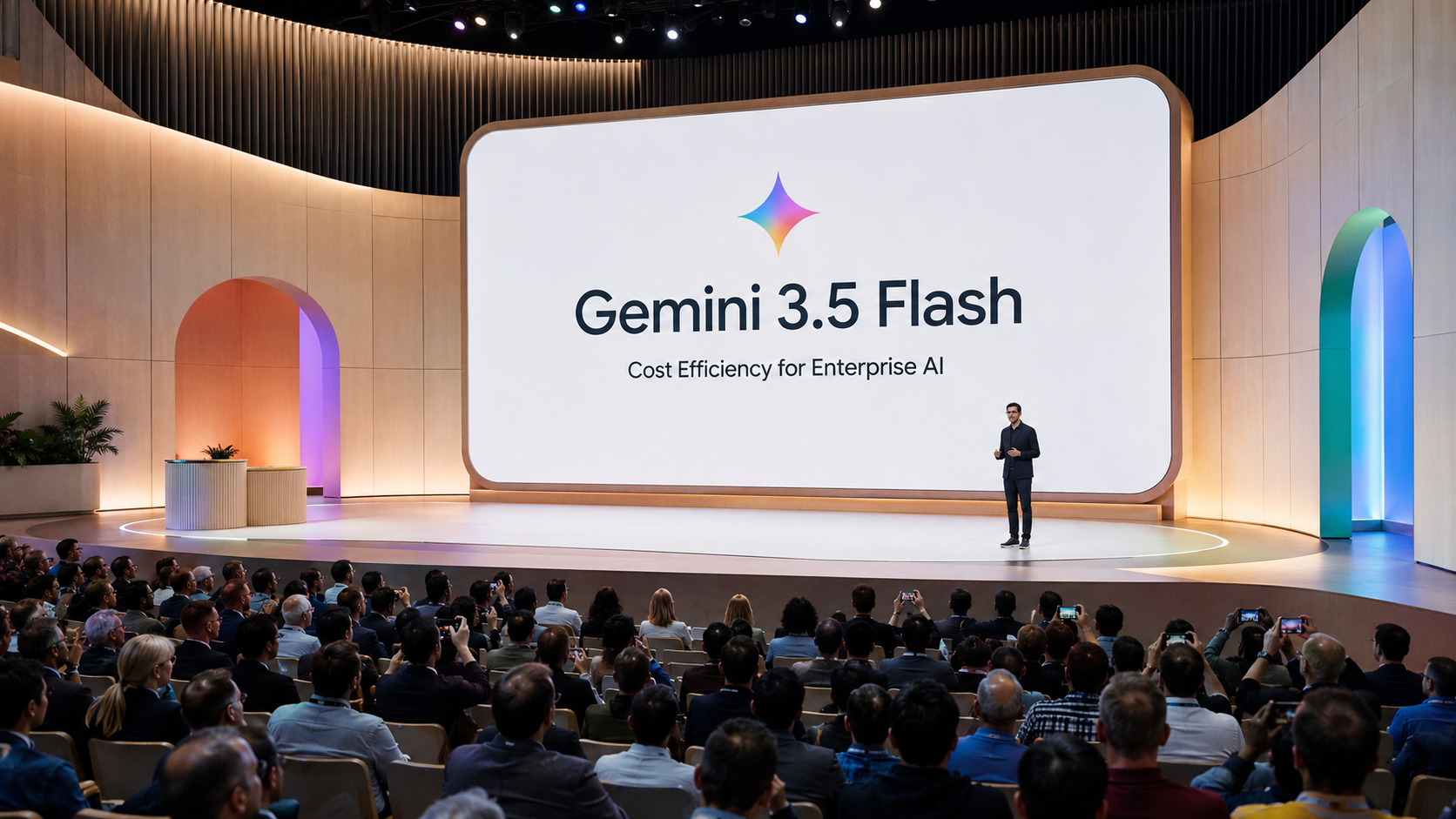



Google is aiming Gemini 3.5 Flash at one of the least glamorous but most urgent problems in enterprise AI: token bills. Announced at I/O 2026, the new model is being positioned as a lower-cost proprietary frontier option for companies that want to run more AI agents without watching budgets disappear by midyear.
The move comes as enterprise AI shifts from occasional chatbot use toward background agents that read, reason, call tools, and take action repeatedly. That workflow can burn through tokens quickly, especially when companies rely on expensive frontier models for every step of a task.
Google Wants AI Agents To Cost Less
Google says Gemini 3.5 Flash costs $1.50 per million tokens, a price point meant to make agentic workflows easier to justify at scale. CEO Sundar Pichai framed the model as part of a mixed-model strategy, where enterprises use lower-cost models for routine work and reserve heavier models for tasks that truly need them.
That message lands in a market already under pressure. Anthropic has lowered prices for its latest Claude Opus model, while open source and non-proprietary models continue to improve. For enterprises, the question is no longer only which model performs best in a benchmark. It is which model can run thousands of useful actions without creating an unpredictable operating expense.
Gemini 3.5 Flash is Google’s answer to that budget anxiety. The company is betting that speed, price, and tight cloud integration can become as important as raw model intelligence, especially for businesses trying to move beyond pilots into daily production use.
Spark And Antigravity Push The Agent Strategy
Google also introduced Gemini Omni Flash, a multimodal model designed to generate outputs across text, image, and video from different input types. But the broader strategic signal is in the agents around Gemini 3.5 Flash.
Gemini Spark is Google’s new personal AI agent for users and developers. It runs on dedicated Google Cloud machines and works across Gmail, Docs, Sheets, Slides, and third-party tools through the Model Context Protocol. In practice, Google wants Spark to handle the connective tissue of work: compiling information, managing RSVPs, updating spreadsheets, and sending reminders under user direction.
The company also updated Antigravity 2.0, its agentic development platform, with a more agent-first desktop experience. Google said the platform was able to build a complete operating system from scratch in 12 hours while using less than $1,000 in API credits, a claim designed to underline both capability and cost control.
The Enterprise Tradeoff
Google’s announcements show how quickly the AI platform race has moved from model launches to full work systems. Vendors are no longer selling intelligence alone. They are selling agents, workflow access, cloud execution, governance, and pricing models that make repeated automation possible.
That pace creates a second challenge for enterprises. Every new model or agent platform promises better economics, but it also forces teams to keep testing, revising, and governing their stacks. Gemini 3.5 Flash may reduce token pressure, but the bigger question is whether companies can build stable AI operations while the ground keeps moving under them.
Comments
No comments yet. Be the first to share your thoughts.
Sign in or create an account to leave a comment.