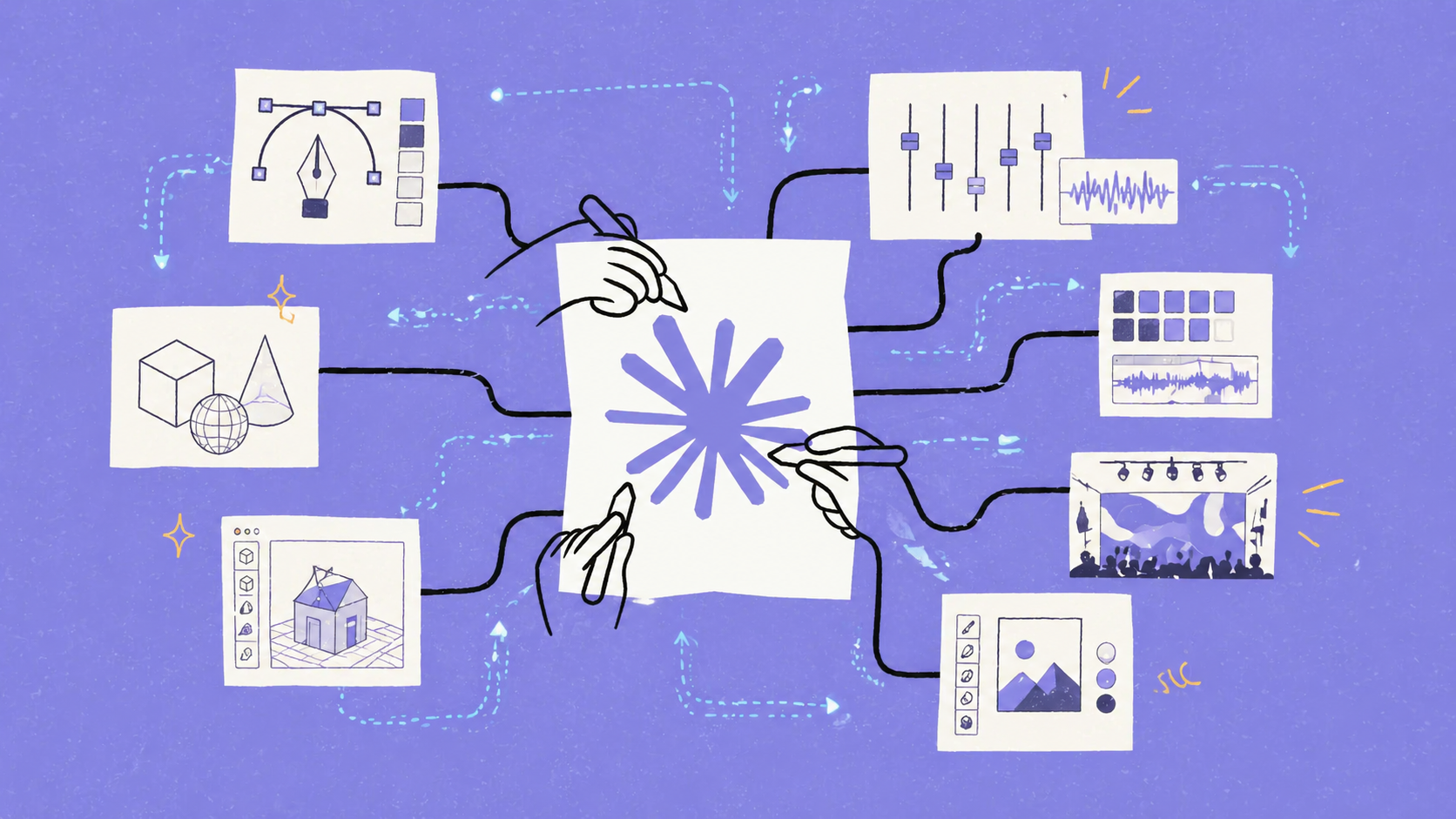



Anthropic is moving Claude deeper into the creative software stack with a new set of connectors for tools used in design, 3D modeling, audio production, visual performance, and professional production work. The announcement brings Claude closer to applications including Adobe Creative Cloud, Blender, Autodesk Fusion, Ableton, Splice, SketchUp, Resolume, and Affinity by Canva.
The pitch is not that Claude should replace creative taste. It is that Claude can reduce the friction around learning tools, scripting workflows, moving assets between systems, and automating the repetitive production work that often sits between idea and finished piece.
Claude Moves Into the Creative Toolchain
In its Claude for Creative Work announcement, Anthropic frames connectors as a way for Claude to work inside the software creative professionals already trust. That is a meaningful shift from asking an AI assistant for advice in one window while doing the actual work somewhere else.
The partner list is broad. Ableton support is aimed at grounding Claude’s answers in official Live and Push documentation. Adobe’s connector is described as a way to help users create and refine images, videos, and designs across Creative Cloud apps. Affinity by Canva focuses on production tasks such as batch adjustments, layer renaming, exports, and custom in-app features.
Autodesk Fusion brings the same idea into product design and engineering, where users can create or modify 3D models through conversation. SketchUp turns prompts into starting points for 3D scenes that can later be refined manually. Splice lets music producers search royalty-free samples from inside Claude, while Resolume’s connectors target live visual artists who want natural-language control over performance and AV production tools.
Blender Is the Most Important Signal
The Blender connector may be the most strategically important part of the announcement. Blender is open source, heavily scriptable, and widely used across indie games, animation, visual effects, architecture, and motion graphics. That makes it a strong test case for whether AI assistants can become practical collaborators inside complex creative environments.
Anthropic says Blender developers have created an MCP connector that is now officially available for Claude. Through Blender’s Python API, the connector can help analyze scenes, debug complex setups, batch-apply changes, and even add new tools directly to Blender’s interface.
The MCP detail matters. Because the connector is built on the Model Context Protocol, the integration is not only a Claude-specific shortcut. Anthropic says it can be accessible to other large language models too, which fits Blender’s open-source culture and gives creative software makers a more interoperable path for AI integrations.
Anthropic also said it has joined the Blender Development Fund as a patron. That is both a symbolic and practical move: the stronger Blender’s Python API and extension ecosystem become, the more useful AI-driven creative workflows can become around it.
The Bigger Bet Is Creative Automation Without Leaving the Tools
Anthropic’s examples point to a broader thesis: creative professionals do not just need image or music generation. They need help navigating software, writing scripts, building plugins, translating formats, managing assets, and moving ideas across design, 3D, audio, and code.
That overlaps with the company’s recent launch of Claude Design, which is meant to help users explore software experiences visually and export work to other tools, starting with Canva. Together, Claude Design and the new creative connectors suggest Anthropic is trying to cover more of the path from concept to execution.
For studios and creative teams, the practical value could be less about one spectacular AI-generated output and more about shaving hours from routine work. A designer could ask Claude to explain a feature, a 3D artist could generate a procedural script, a producer could search samples, and a team could keep assets aligned across a pipeline without as many manual handoffs.
Education Gives Anthropic a Feedback Loop
Anthropic is also working with art and design programs to support creative computation curricula. The first programs named are Art and Computation at Rhode Island School of Design, Fundamentals of AI for Creatives at Ringling College of Art and Design, and the MA/MFA Computational Arts program at Goldsmiths, University of London.
That education angle is more than community outreach. Students and faculty are likely to stress-test these tools in ways that enterprise teams may not, especially around creative control, authorship, pedagogy, and the boundary between assistance and automation.
The central question is whether Claude can become useful without flattening the creative process into generic prompts. Anthropic’s answer is to meet artists and producers inside their existing tools, where taste, iteration, and craft still matter. If that works, Claude’s role in creative work may be less about replacing the blank canvas and more about removing the machinery that gets in the way of using it.
Comments
No comments yet. Be the first to share your thoughts.
Sign in or create an account to leave a comment.