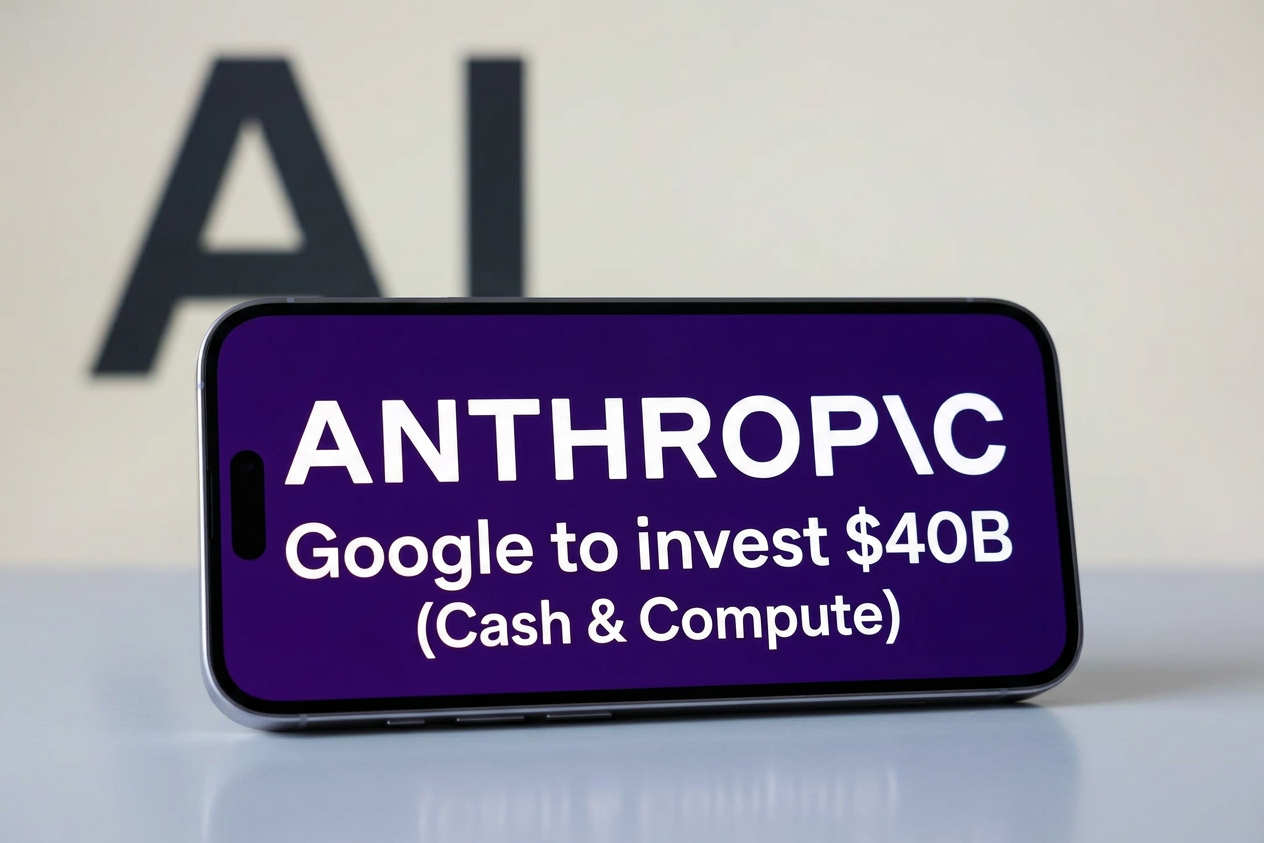



Google is preparing to put far more capital behind Anthropic, with a reported package worth up to $40 billion in cash and compute support. According to the source material, the deal includes a $10 billion investment now at a $350 billion valuation, with another $30 billion available if Anthropic hits certain performance targets.
The headline number is enormous, but the more important story is capacity. Anthropic is trying to keep Claude competitive at a moment when frontier AI is becoming less a pure model race and more a contest over who can secure enough chips, power, cloud access, and reliable inference capacity to serve global demand.
Google Is Both Rival and Supplier
Google is a direct competitor to Anthropic in foundation models, but it is also one of Anthropic’s most important infrastructure suppliers. Anthropic already relies heavily on Google Cloud, including access to Google’s tensor processing units, or TPUs, which are custom AI chips designed for training and serving large models.
That dual role is no longer unusual in the AI market. The largest labs compete on models while depending on each other, or on each other’s cloud partners, for the industrial machinery behind those models. The result is a strange but rational market structure: rivals fund, host, and supply each other because compute scarcity is more urgent than clean competitive boundaries.
Anthropic’s relationship with Google has been deepening for months. Earlier this month, Anthropic announced a Google and Broadcom compute partnership to access multiple gigawatts of TPU-based capacity beginning in 2027. A later Broadcom securities filing reportedly put that figure at 3.5 gigawatts. The new Google commitment would expand the arrangement further, with Google Cloud providing another 5 gigawatts of capacity over the next five years and room to scale beyond that.
Mythos Raises the Stakes
The reported investment lands shortly after Anthropic began giving a limited group of partners access to Mythos, its latest and most powerful model. Anthropic has described Mythos as having significant cybersecurity applications, which makes restricted access unsurprising. A model that can materially help with cyber defense can often be redirected toward cyber misuse if access controls fail.
That risk is not theoretical. Bloomberg has reported that Anthropic’s Mythos model was accessed by unauthorized users, adding pressure on the company to prove that it can safely manage frontier capability while scaling commercial access.
Mythos is also likely expensive to run. That matters because advanced model launches now create an immediate infrastructure problem: if a model is good enough to attract enterprise demand, it must be served reliably, securely, and at scale. For Anthropic, more Google compute is not just a balance-sheet story. It is product infrastructure.
Anthropic Is Buying Capacity Everywhere
Google is not the only major infrastructure partner Anthropic is leaning on. The company recently struck a cloud capacity agreement with CoreWeave, and it has also expanded its Amazon relationship with an additional $5 billion investment and a broader agreement tied to roughly 5 gigawatts of compute capacity over time.
Those deals are arriving as Anthropic faces visible scaling pressure. Recent complaints about Claude use limits and performance issues have made infrastructure constraints part of the company’s public story, not just an internal operations issue. Fortune’s reporting on Claude performance and user backlash points to the same practical reality: customers do not experience frontier AI as a valuation or benchmark. They experience it as latency, limits, reliability, and whether the model is available when work needs to get done.
OpenAI is making the same calculation from the other side of the market. Its reported plan to spend more than $20 billion on Cerebras chips shows how aggressively top labs are trying to secure alternatives to constrained GPU supply chains.
The Valuation Story Is Really an Infrastructure Story
Anthropic’s valuation reportedly stood at $350 billion as recently as February, with investors now interested in backing the company at $800 billion or more. The company is also said to be considering an IPO as soon as October. Those numbers are startling, but they make more sense when viewed through the lens of compute access.
If Anthropic can secure enough cloud capacity to turn Claude and Mythos into dependable enterprise platforms, its market opportunity expands. If it cannot, model quality alone will not be enough. The next phase of AI competition will reward labs that can pair frontier capability with industrial-scale delivery.
Google’s proposed $40 billion package is therefore not just a financial endorsement of Anthropic. It is a bet that the winner of the AI race will be determined as much by power contracts, custom silicon, and cloud commitments as by the model weights themselves.
Comments
No comments yet. Be the first to share your thoughts.
Sign in or create an account to leave a comment.