Key Grok Stats
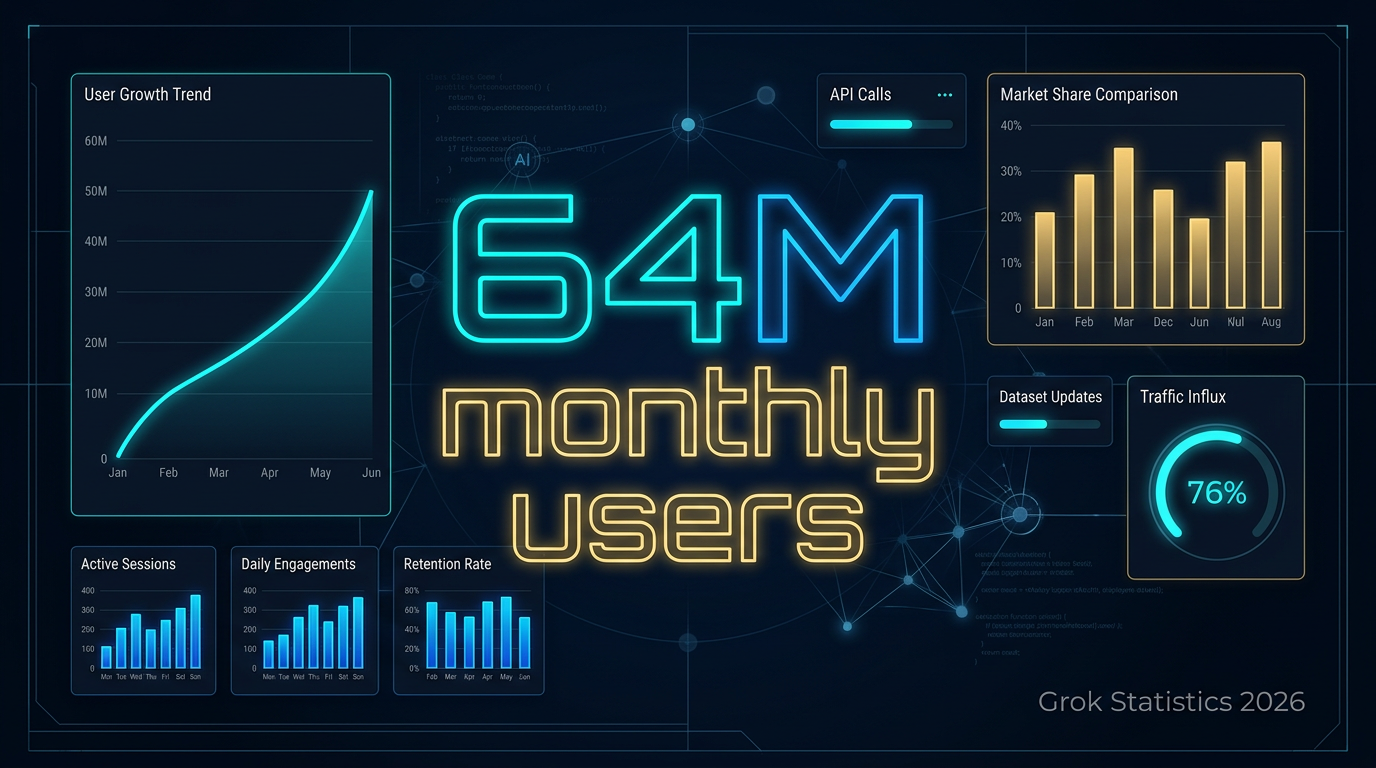
- Grok reportedly reached 64 million monthly users by September 2025.
- Grok held 17.8% of the US chatbot market in January 2026, up from 1.9% a year earlier.
- grok.com recorded 298.6 million monthly visits in February 2026.
- Average visit duration reached 12 minutes and 57 seconds, with 21.41 pages per visit.
- xAI raised $20 billion in January 2026 at a reported $230 billion valuation.
- Standalone xAI revenue reached $107 million for Q3 2025, while combined xAI plus X annualized revenue was estimated at $3.83 billion.
- Grok 4.1 ranked first on LMArena at 1483 Elo and was preferred 64.78% of the time over the prior production model.
- xAI secured a US government contract priced at $0.42 per organization through March 2027.
Grok has moved from a fast-following AI chatbot into a serious competitive entrant with enough scale to show up in user, traffic, funding, and market-share datasets at the same time. The product is still smaller than ChatGPT and Gemini on the biggest top-line usage measures, but its growth curve is now large enough that it can no longer be dismissed as a curiosity tied only to X.
The most useful way to read Grok’s numbers is across layers. Consumer usage and web traffic show demand, market-share data shows competitive traction, model-ranking data shows technical credibility, and xAI’s funding plus revenue signals show how aggressively the company is trying to scale distribution and infrastructure behind the product.
How Many People Use Grok?
The strongest public user figure in the source set is 64 million monthly users in September 2025. That is still much smaller than the largest AI assistants, but it is large enough to matter in a category where only a few products have broken into tens or hundreds of millions of repeat users.
The web layer reinforces that point. Third-party traffic estimates put grok.com at 298.6 million monthly visits in February 2026, even after a modest month-over-month decline. That suggests Grok is already operating at large consumer-web scale before fully counting embedded usage inside X and mobile surfaces.
| Label | Comparable public checkpoints |
|---|---|
| Jan 2025 | 1.9 |
| Dec 2025 | 14 |
| Jan 2026 | 17.8 |
| Feb 2026 | 298.6 |
This chart combines different public checkpoint types: US chatbot market share in early 2025 and 2026, plus monthly web visits in February 2026. These figures are directional and should not be read as a single continuous user series.
Grok User Growth and Market Share
The clearest competitive signal in the source file is the change in US chatbot share. Grok reportedly moved from 1.9% in January 2025 to 14% in December 2025, then to 17.8% in January 2026. That is an unusually fast gain for a product still building its long-term enterprise and app footprint.
This matters because market-share movement is often harder to win than raw signups. A new chatbot can attract trial users around a model launch, but sustained category-share gains suggest Grok is becoming part of regular user consideration alongside ChatGPT and Gemini, not simply spiking on novelty.
| Metric | Value | Period |
|---|---|---|
| Reported monthly users | 64M | Sep 2025 |
| US chatbot market share | 1.9% | Jan 2025 |
| US chatbot market share | 14% | Dec 2025 |
| US chatbot market share | 17.8% | Jan 2026 |
| Monthly web visits | 298.6M | Feb 2026 |
The table mixes first-party-style usage milestones with market-share and third-party web-traffic estimates, which measure different aspects of adoption.
Grok Website Traffic and Engagement
Traffic-quality metrics are one of the more interesting parts of the dataset because they suggest more than one-off curiosity. The source file lists 12 minutes and 57 seconds average visit duration, 21.41 pages per visit, and a 26.48% bounce rate for February 2026. Those are strong engagement signals for a chatbot web product.
Geographically, the desktop audience was led by the United States at 23.68%, followed by India at 8%, Brazil at 5.21%, South Korea at 3.56%, and Hong Kong at 3.13%. That mix points to a product with real international reach rather than a single-market audience.
Demographically, the reported audience skewed 67.46% male and 32.54% female, with ages 25 to 34 as the largest segment and 18 to 24 as the second largest. That profile looks similar to many fast-growing AI products that first gain traction among digitally native early adopters.
| Metric | Value | Context |
|---|---|---|
| Monthly visits | 298.6M | February 2026 |
| Average visit duration | 12:57 | February 2026 |
| Pages per visit | 21.41 | February 2026 |
| Bounce rate | 26.48% | February 2026 |
| US traffic share | 23.68% | Desktop audience |
| Largest age group | 25-34 | Audience profile |
Traffic, geography, and demographic figures reflect third-party measurement snapshots rather than audited first-party analytics.
xAI Revenue, Funding, and Business Scale
The company-level numbers show how aggressively xAI is being capitalized behind Grok. The source set says xAI raised $20 billion in January 2026 at a reported $230 billion valuation, making it one of the biggest private AI funding events on record.
Revenue is still much smaller than the valuation headline, but it is no longer trivial. xAI reportedly generated $107 million in quarterly revenue for the period ended September 30, 2025, while a separate estimate put combined xAI plus X annualized revenue at $3.83 billion, with about $500 million of that tied to xAI on a standalone annualized run-rate basis.
That gap between current revenue and capital intensity is important. It suggests Grok is being financed as part of a much larger infrastructure and distribution strategy, not as a narrowly optimized chatbot business trying to maximize near-term margins.
| Metric | Latest value | Context |
|---|---|---|
| Quarterly revenue | $107M | Q3 2025 |
| Standalone annualized run-rate | $500M | Estimated |
| Combined xAI + X annualized revenue | $3.83B | Estimated |
| Capital raised | $20B | January 2026 |
| Valuation | $230B | Reported January 2026 |
| Government contract price | $0.42 | Per organization through Mar 2027 |
Revenue and valuation figures come from reported estimates and banker materials rather than public-company filings.
Grok Enterprise and Public-Sector Adoption
Enterprise adoption is still earlier and less transparent than Grok’s consumer usage story, but the available signals matter. xAI has introduced Grok Business and Grok Enterprise, with controls such as SSO, audit logging, role-based access controls, and compliance positioning around SOC 2, GDPR, and CCPA.
The strongest public proof point is the US federal deal in the source file. Agencies were reportedly able to access Grok through a GSA contract running through March 2027, with entry pricing at $0.42 per organization and upgrade paths to higher-usage enterprise subscriptions. Even if that contract price is mainly a distribution wedge rather than a major revenue driver, it signals that xAI is pushing hard to establish institutional footholds early.
Grok Model Performance and Competitive Position
The technical-performance layer also matters because Grok’s adoption is not only a distribution story. The source file says Grok 4.1 ranked first on LMArena at 1483 Elo and was preferred 64.78% of the time over the previous production model. Those rankings do not map cleanly to real-world market share, but they do help explain why Grok has remained visible in a crowded model market.
Competitively, Grok still trails the biggest assistants on the broadest usage metrics. The same source set places ChatGPT at 800 million plus weekly active users, Gemini at 750 million monthly active users, and Grok at 64 million monthly users. Those are not like-for-like measurements, but they still make the scale hierarchy clear: Grok is meaningful, fast-growing, and increasingly relevant, yet still substantially behind the top two platforms.
What the Data Tells Us
Grok’s story in 2026 is not just that it has become bigger. It is that the product now has enough measurable scale across usage, traffic, market share, model rankings, funding, and public-sector adoption to be treated as a real top-tier challenger. The main question is no longer whether Grok can attract attention. It is whether xAI can turn that momentum into durable user habit, broader enterprise adoption, and a business that eventually grows into its capital base.
Related AI Statistics
For the closest competitive comparisons, read ChatGPT and OpenAI Statistics 2026 for the category leader’s much larger user and revenue base, Google Gemini Statistics 2026 for Google’s ecosystem-driven scale across Search and enterprise, Claude Statistics 2026 for a smaller but credible rival with a younger web audience, and Perplexity Statistics 2026 for another fast-growing AI product building habit through repeated search-style usage. For sector adoption signals, see AI in Education Statistics 2026 and AI in Marketing Statistics 2026.