


Definition
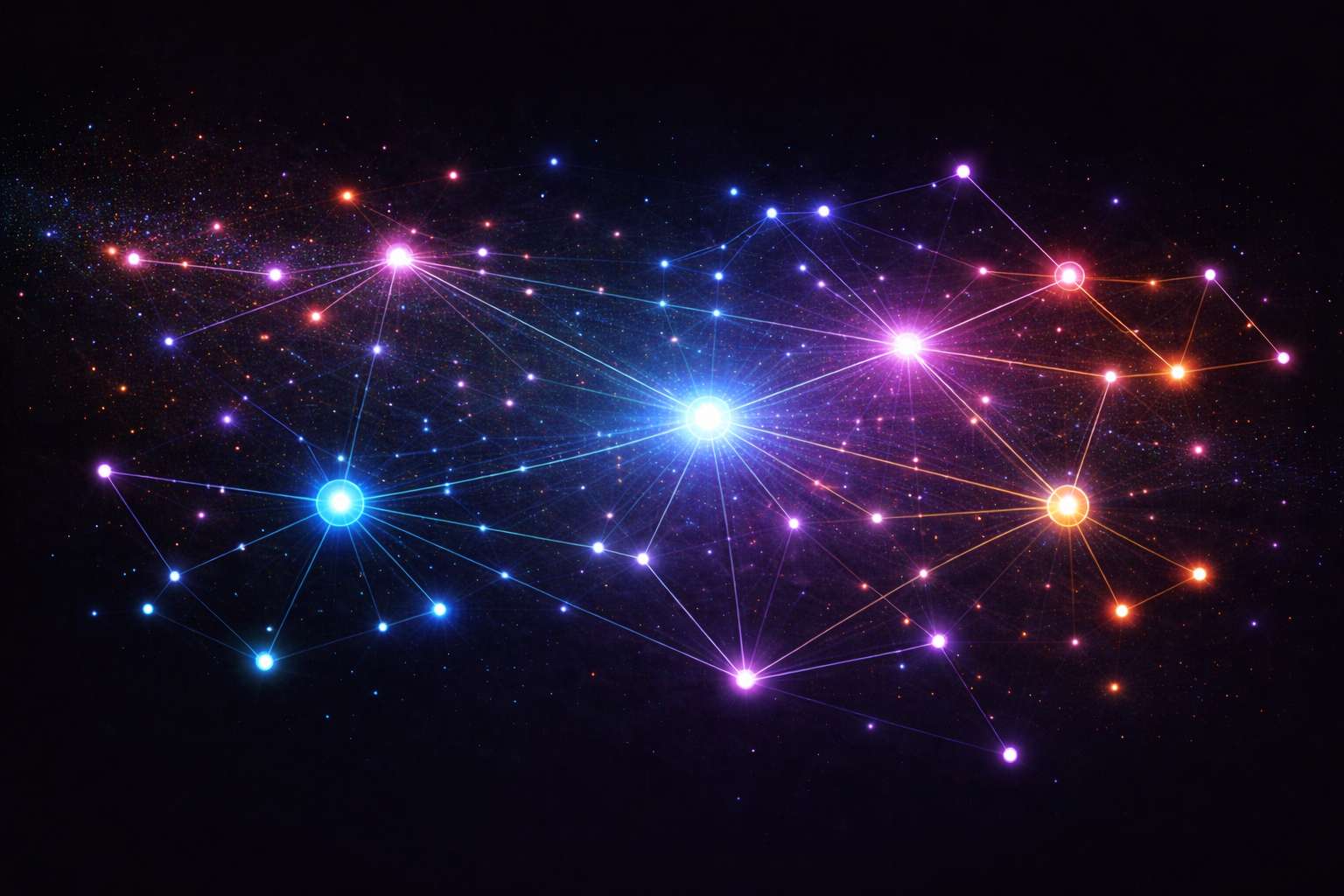
In the world of artificial intelligence, a “Knowledge Graph” is a “Structured World Map” for data. While a standard Vector Database stores information as mathematical Embeddings in a cloud of similar “meanings,” a knowledge graph stores it as a network of “Nodes” (entities) and “Edges” (relationships). For example, a knowledge graph would have a node for “Steve Jobs,” another for “Apple,” and a link between them labeled “Co-Founder.” This “explicit” structure allows an AI to “Reason” across paths that are difficult for a text-only model—like finding “all companies founded by people who graduated from Reed College.” It transforms “unstructured” text into a “schematic” of facts that are 100% verifiable and logically sound.
Why It Matters
The significance of knowledge graphs is their role in Reliability and Explainability. One of AI’s biggest problems is Hallucination—where a model confidently makes up a fact. A Large Language Model might “statistically guess” that two people are related because they often appear in the same news articles, but a knowledge graph knows they are related because it has a formal record of that fact.
For industries like Health, Law, and Finance, knowledge graphs are the “Factual Guardrails” that make AI safe for professional use. By “Grounding” an AI in a knowledge graph, a company can ensure that every claim the model makes is backed by a structured, “proven” relationship. This is critical for Enterprise Knowledge Retrieval, as it allows an organization to build its own internal “Fact-Base” that an AI can use to answer complex questions without the risk of “drifting” into fiction. Knowledge graphs are the “Bridge” between the “Intuitive” side of AI (neural networks) and the “Logical” side (symbolic reasoning), a field known as Neuro-Symbolic AI.
How It Works
A knowledge graph works through a sophisticated “Triplet” structure (Subject-Predicate-Object).
- Entity Extraction: An AI “reads” a document and identifies “Entities”—like “Microsoft,” “Satya Nadella,” and “CEO.”
- Relationship Mapping: The system then identifies how these entities are connected. It creates a “Triplet”:
[Satya Nadella] - [is the CEO of] - [Microsoft]. - Graph Construction: These triplets are added to a central database, forming a massive “Web” of facts. If another triplet is added—
[Microsoft] - [is headquartered in] - [Redmond]—the system now “knows” that Satya Nadella works in Redmond, even if that was never explicitly stated in one document. - Querying and Reason: When a user asks a question, the system converts that question into a “Graph Search.” Instead of just looking for matching keywords, it “Walks” the graph’s paths to find the answer.
- LLM Integration: The retrieved facts from the graph are then sent to a Large Language Model to be summarized into a final, natural-sounding response.
This “End-to-End” process happens in milliseconds, allowing for a “Deep Reasoning” search experience that a simple keyword or vector search can’t match.
Applications
Knowledge graphs are the engine behind Google Search. When you see a “Knowledge Panel” on the right side of your search results—showing a person’s birthday, spouse, and list of movies—you are looking at data retrieved from Google’s massive internal knowledge graph. It’s what allowed Google to move from “searching for strings” to “searching for things.”
In E-Commerce and Retail, knowledge graphs power Customer-Centric Recommendations. When Amazon suggests a “matching accessory” for a product you just bought, it’s often because their knowledge graph “knows” that those two items have a “Highly Compatible” relationship. This is far more accurate than just suggesting items in the same “Category.”
For Healthcare and Medical Research, knowledge graphs are used for “Drug Repurposing.” By mapping out millions of relationships between “Symptoms,” “Diseases,” “Genes,” and “Drugs,” researchers can “Reason” across the graph to find a drug that was designed for one condition but might be remarkably effective for another. Finally, in Personal Productivity, knowledge graphs allow apps like Apple’s Siri or Notion to “connect the dots” between your meetings, your project files, and your team members, providing a “holistic” view of your work.
Limitations
The biggest challenge with knowledge graphs is “Construction and Maintenance.” While a Vector Database can just “ingest” a PDF, a knowledge graph requires a “Schema”—a set of rules for what types of entities and relationships are allowed. This makes “Building” a high-quality knowledge graph a massive engineering and manual-data-entry undertaking.
There is also the “Data Sparsity” issue. A knowledge graph is only as good as the “Pathways” it contains. If your graph doesn’t have a link between “Entity A” and “Entity B,” the AI will “fail” to find the connection, even if it’s obvious to a human. This makes Graph Completion—using AI to “predict” missing links—one of the most important research areas in $the field$.
Finally, “Scaling” is a factor. As a knowledge graph grows to billions of nodes and trillions of edges, the “Mathematical Complexity” of “Walking the Graph” can become too slow for real-time applications. This requires advanced “Graph Partitioning” and “Distributed Computing” techniques to ensure the system remains snappy. Despite these hurdles, managing Inference costs and building a robust “Memory Layer” is the top priority for any developer building modern AI applications.
Related Terms
- Large Language Model (LLM): The conversational “brain” that “queries” the knowledge graph to find relevant facts.
- Retrieval-Augmented Generation (RAG): The framework that uses a knowledge graph to help AI “look things up” in the real world.
- Reasoning Model: An advanced type of AI often used to “Reason” across the complex paths of a knowledge graph.
- Grounding: The process of ensuring an AI’s response is based on the data retrieved from a knowledge graph.
- Vector Database: An alternative “Memory Layer” that stores information as “meanings” rather than “structured facts.”
- Embeddings: The mathematical “meaning vectors” that can be used to “Enrich” a knowledge graph with semantic similarity.
Further Reading
- Google: Introducing the Knowledge Graph — The original post from 2012 that explained how Google moved from “strings” to “things.”
- What is a Knowledge Graph? (IBM) — A professional, business-focused breakdown of the history and technical methods of graph-based data storage.
- Neo4j: Knowledge Graphs and Large Language Models — A technical look at how graph databases are being used to “Ground” the modern AI tech stack.
- Wikipedia: Knowledge Graph — A comprehensive overview of the history, technical methods, and market landscape of knowledge graphs in AI.