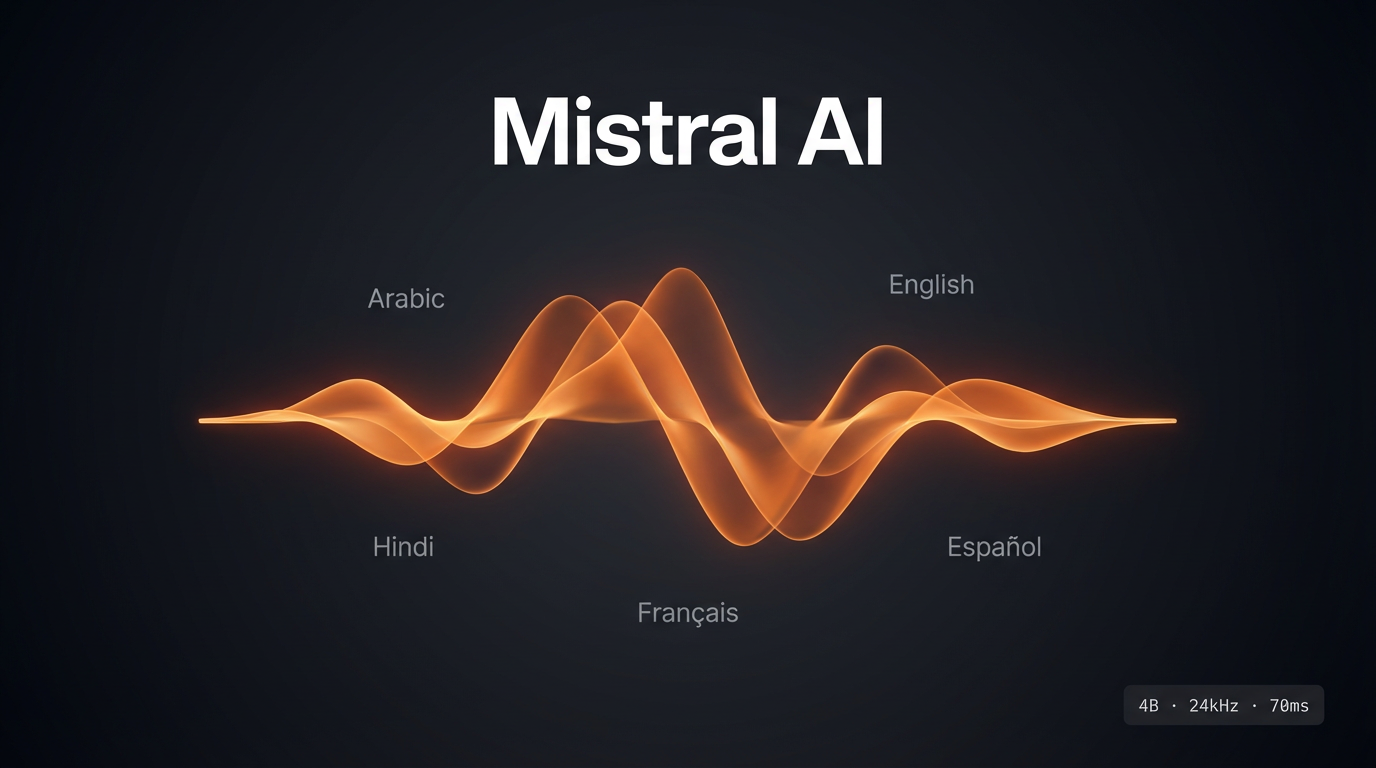
Text-to-speech has been a solved problem for years — if you don’t mind robotic, monotone output that immediately signals “this is a machine.” Building voice agents that feel natural, respond in real time, and work across multiple languages without sounding like they’re reading from a script has been an entirely different challenge. That’s the gap Mistral AI is targeting with Voxtral 4B TTS 2603 — a frontier, open-weights text-to-speech model purpose-built for the demands of production voice agent infrastructure.
Released with BF16 weights, a detailed technical writeup on the Mistral blog, full documentation, and a research paper for the technically inclined, Voxtral is Mistral’s most direct entry into the voice layer of the AI stack. Here’s a complete breakdown of what it is, how it works, and who should be paying close attention.
What Is Voxtral 4B TTS 2603?
Voxtral 4B TTS 2603 is a 4-billion-parameter, open-weights text-to-speech model built on top of Ministral-3-3B-Base-2512 — Mistral’s compact base language model. The model weights are hosted on Hugging Face and released in BF16 format. The “TTS 2603” naming follows Mistral’s date-based versioning convention, placing the release in March 2026.
The model takes text as input and produces high-quality, naturally-paced speech audio as output. It ships with 20 preset voices, instant voice adaptation capabilities, and support for streaming and batch inference — making it suitable both for real-time interactions and high-throughput background processing.
What sets it apart from proprietary alternatives isn’t just the open-weights nature of the release. It’s the combination of low latency, expressive output, multilingual range, and a single-GPU footprint — a set of trade-offs that very few TTS systems have managed to hit simultaneously.
The Numbers That Matter
Before getting into use cases, the performance benchmarks are worth examining directly. All tests were run on a single NVIDIA H200 using 500-character text inputs with a 10-second audio reference:
- Concurrency 1 — 70ms latency, RTF of 0.103, throughput of 119 characters per second per GPU
- Concurrency 16 — 331ms latency, RTF of 0.237, throughput of 879 characters per second per GPU
- Concurrency 32 — 552ms latency, RTF of 0.302, throughput of 1,430 characters per second per GPU
An RTF (Real-Time Factor) below 1.0 means the model generates audio faster than it plays back — so at concurrency 1, Voxtral produces audio roughly 10x faster than real time. At 32 concurrent requests, it’s still generating faster than playback. That headroom is what makes it viable for real-time voice agent deployments where latency is user-visible.
The output is delivered at 24 kHz and supports WAV, PCM, FLAC, MP3, AAC, and Opus formats — covering virtually every downstream integration requirement without post-processing.
9 Languages, 20 Voices, Instant Adaptation
Voxtral supports nine major languages with natural prosody and dialect awareness across each:
English · French · Spanish · German · Italian · Portuguese · Dutch · Arabic · Hindi
For teams building globally-deployed voice products, this isn’t just a feature list item — it’s a significant operational simplification. Running a single model that handles Arabic and Hindi alongside European languages, with the prosodic intelligence to make each sound natural, eliminates the model-per-language architecture that most enterprise TTS deployments currently require.
The 20 preset voices cover a range of tones and registers — casual, professional, neutral — and the model supports instant adaptation to new voice profiles. For companies that need a voice agent to sound like a specific brand persona or regional representative, voice customization details are covered in Mistral’s official documentation without model retraining.
8 Industries Where Voxtral Changes the Calculus
1. Customer Support and Call Centers
This is the highest-volume deployment scenario for production TTS. Call center infrastructure runs 24/7, handles enormous concurrent load, and punishes latency severely — a voice agent that pauses mid-sentence loses the caller. Voxtral’s throughput profile (1,430 characters/second/GPU at 32 concurrent connections) and sub-100ms first-audio latency make it technically viable for this environment in a way that many existing TTS systems are not.
2. Financial Services and KYC
Mistral specifically highlights banking KYC voice agents as a target use case — including a video demo. Identity verification workflows need voices that communicate authority and precision without sounding scripted. Voxtral’s expressive prosody and the ability to customize voice profiles to match regional expectations make it a strong fit for compliance-adjacent interactions where tone directly affects user trust.
3. Healthcare and Patient Communication
Appointment reminders, medication instructions, post-discharge follow-ups — healthcare communication is high-stakes, often multilingual, and increasingly automated. The Hindi and Arabic support in Voxtral is particularly relevant here, covering patient populations that are systematically underserved by English-primary TTS systems.
4. Automotive and In-Vehicle Systems
In-vehicle AI assistants have strict latency requirements — a voice response that arrives 500ms after a driver query is already disruptive in a safety-critical context. Voxtral’s 70ms time-to-first-audio at single concurrency puts it within the range of acceptable real-time performance for embedded or edge-deployed automotive applications, assuming the hardware can support a 16GB+ GPU footprint.
5. Real-Time Translation and Interpretation
Streaming audio output support plus multilingual coverage creates a viable pathway for real-time spoken translation. A user speaks in French, the system processes and translates, and Voxtral outputs natural-sounding Spanish within a conversational pause. The latency profile makes this use case realistic in ways that it simply wasn’t with earlier-generation TTS systems.
6. Sales and Marketing Automation
Personalized outbound voice campaigns, dynamic product narration, and interactive sales bots all benefit from voices that don’t immediately signal automation. Voxtral’s natural prosody — particularly its handling of emotional range — is the differentiator here. A voice that sounds like it cares whether the customer says yes performs better than one that sounds like a phone tree.
7. Manufacturing and Industrial Operations
Hands-free voice interfaces for factory floors, equipment status read-outs, and safety alert systems need reliability and clarity above all else. Voxtral’s batch inference support means industrial deployments can process large queues of alerts and instructions offline, then stream them to devices on-demand without requiring constant API connectivity.
8. Public Services and Government
Multilingual civic communication — tax notices, public health guidance, election information — has historically required expensive human translation and voice recording workflows. An open-weights model that handles nine languages natively, runs on self-hosted infrastructure, and carries a CC BY-NC 4.0 license opens a deployment pathway that closed, proprietary APIs do not.
How to Run It: The Technical Path
Voxtral runs on any GPU with 16GB or more of VRAM, making it accessible beyond H100/H200 environments. Mistral recommends deploying with vLLM-Omni, a production-grade inference framework developed in close collaboration with the Mistral team.
Installation is straightforward:
uv pip install -U vllm
uv pip install git+https://github.com/vllm-project/vllm-omni.git --upgrade
Serving the model requires a single command:
vllm serve mistralai/Voxtral-4B-TTS-2603 --omniFrom there, the model exposes an OpenAI-compatible /audio/speech endpoint — meaning any codebase already integrated with OpenAI’s TTS API can switch to Voxtral with minimal changes. Full integration instructions and client code examples are in Mistral’s documentation.
The Open-Weights Angle
The CC BY-NC 4.0 license is the detail that changes the strategic conversation for many enterprise teams. Proprietary TTS APIs from major cloud providers offer convenience but impose three constraints that matter at scale: data leaves your infrastructure, per-character pricing compounds aggressively at volume, and the vendor controls the roadmap.
An open-weights model running on self-hosted infrastructure eliminates all three constraints. For organizations in regulated industries — financial services, healthcare, government — the data residency argument alone can make the difference between a deployment that clears legal review and one that doesn’t.
The non-commercial restriction means Voxtral is not a free pass for commercial deployments without review, but Mistral’s managed API provides a path for teams that need commercial terms without managing their own inference stack.
The Bottom Line
Voxtral 4B TTS 2603 is a technically serious model aimed at a real production problem. The latency numbers hold up, the multilingual coverage is genuinely broad, and the single-GPU footprint makes it accessible to organizations that don’t have hyperscaler infrastructure. For teams building voice agents — whether in customer support, financial services, automotive, or public sector — it is now the most credible open-weights option in the space, and one of the most credible options regardless of licensing model.
The blog post, technical documentation, research paper, and model weights on Hugging Face are all available now.
Comments
No comments yet. Be the first to share your thoughts.
Sign in or create an account to leave a comment.