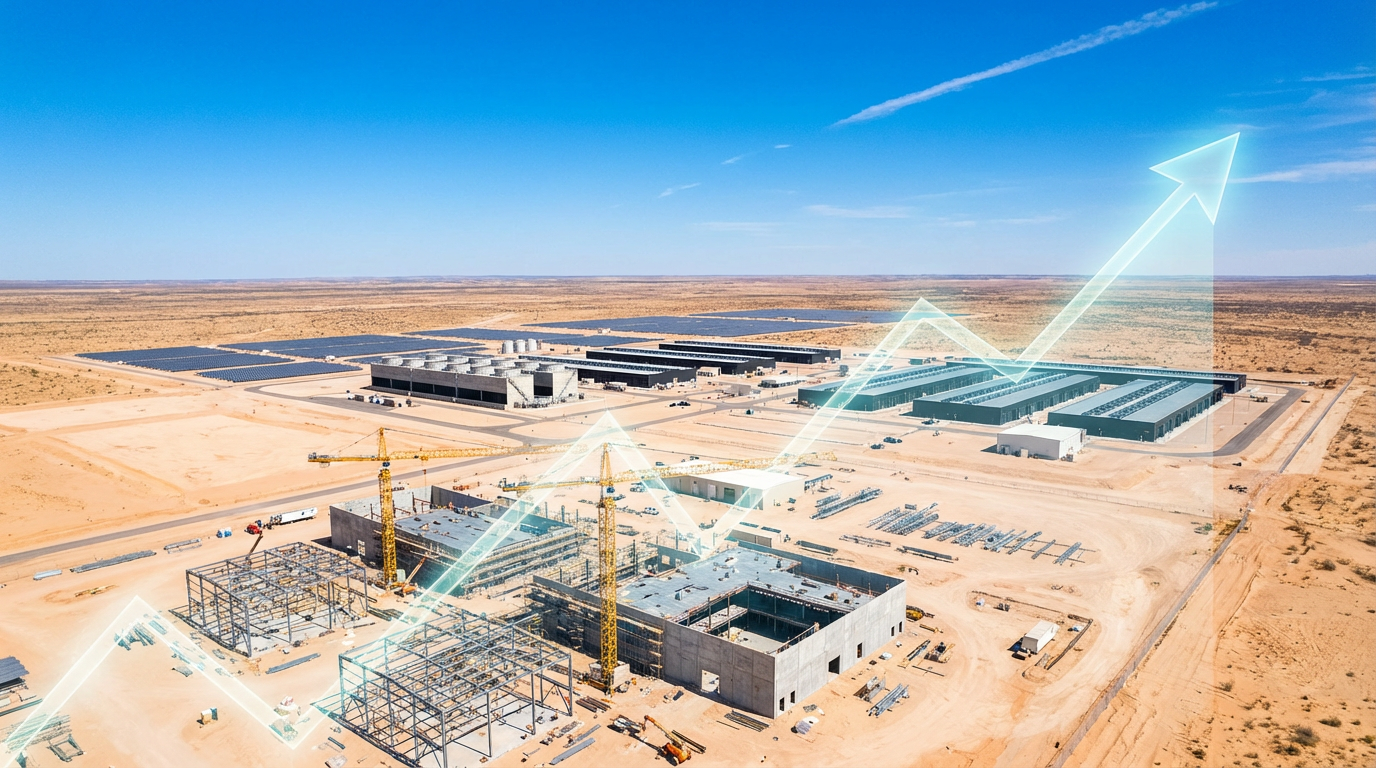
Meta is expanding its planned AI data center in El Paso, Texas from a $1.5 billion project into a more than $10 billion one — a sixfold increase that reflects both the company’s accelerating compute requirements and the broader inflation gripping large-scale AI infrastructure development.
From Anchor Tenant to Gigawatt-Scale Facility
When Meta originally announced the El Paso site in October, the $1.5 billion figure came with relatively modest ambitions: a facility with the ability to scale to one gigawatt of capacity, eventually. The updated announcement removes that qualifier entirely. The center “will grow to one gigawatt,” the company confirmed in a blog post — a commitment that helps explain much of the cost expansion.
The physical and labor footprint has scaled accordingly. The number of construction workers required to build out the 1.2 million square foot site has grown from 1,800 to 4,000. Permanent jobs supported by the facility, once operational in 2028, will rise from around 100 to more than 300.
Addressing Energy and Water Concerns
The announcement was paired with environmental commitments that appear aimed at getting ahead of local concerns about a facility of this scale. Meta’s blog post states the company will add more than 5,000 megawatts of clean energy to the grid — framing the site not as a drain on West Texas power infrastructure but as a net contributor to it.
On water usage, Meta pointed to a closed-loop, liquid-cooled system that recirculates water internally rather than drawing continuously from local sources. The company characterized its consumption as comparable to that of a typical West Texas golf course — a pointed reference designed to land with residents in an arid region where water scarcity is a genuine concern.
The Bigger Picture: $135 Billion and Counting
The El Paso revision lands inside a much larger spending story. Meta’s most recent earnings report, published in January, projected that capital expenditures in 2026 could reach $135 billion — a figure driven almost entirely by the compute infrastructure the company believes it needs to sustain its AI ambitions. A single facility jumping from $1.5 billion to $10 billion is, in that context, an illustration of how quickly those projections can shift.
CEO Mark Zuckerberg has framed 2026 as a landmark year for Meta’s AI deployment, predicting that AI agents would begin taking on the work of full engineering teams and producing a “flattening” of headcount — with projects that previously required large groups now achievable by a single capable individual.
Layoffs Alongside the Build-Out
Those predictions are now translating into concrete workforce reductions. Meta confirmed to The Register that an initial 700 roles are being eliminated in a first wave of cuts. “Teams across Meta regularly restructure or implement changes to ensure they’re in the best position to achieve their goals,” the company said.
The juxtaposition is a sharp one: a $10 billion infrastructure commitment in Texas announced in the same cycle as the first round of AI-attributed job losses at the company responsible for building it.
Further complicating the picture, Meta’s share price fell sharply on Thursday following a California court ruling that found the company had harmed a young user through addictive social media design. The decision has raised concerns among investors about the potential scope of future litigation — adding another variable to an already turbulent cost and valuation environment for the company.
Comments
No comments yet. Be the first to share your thoughts.
Sign in or create an account to leave a comment.