Google is preparing a wave of new capabilities for Gemini for Business, with several hidden features now visible in the platform’s latest development builds. The changes point toward a more integrated, extensible product — and a clearer competitive posture against enterprise AI platforms from Microsoft and others.
NotebookLM Comes to the Business Tier
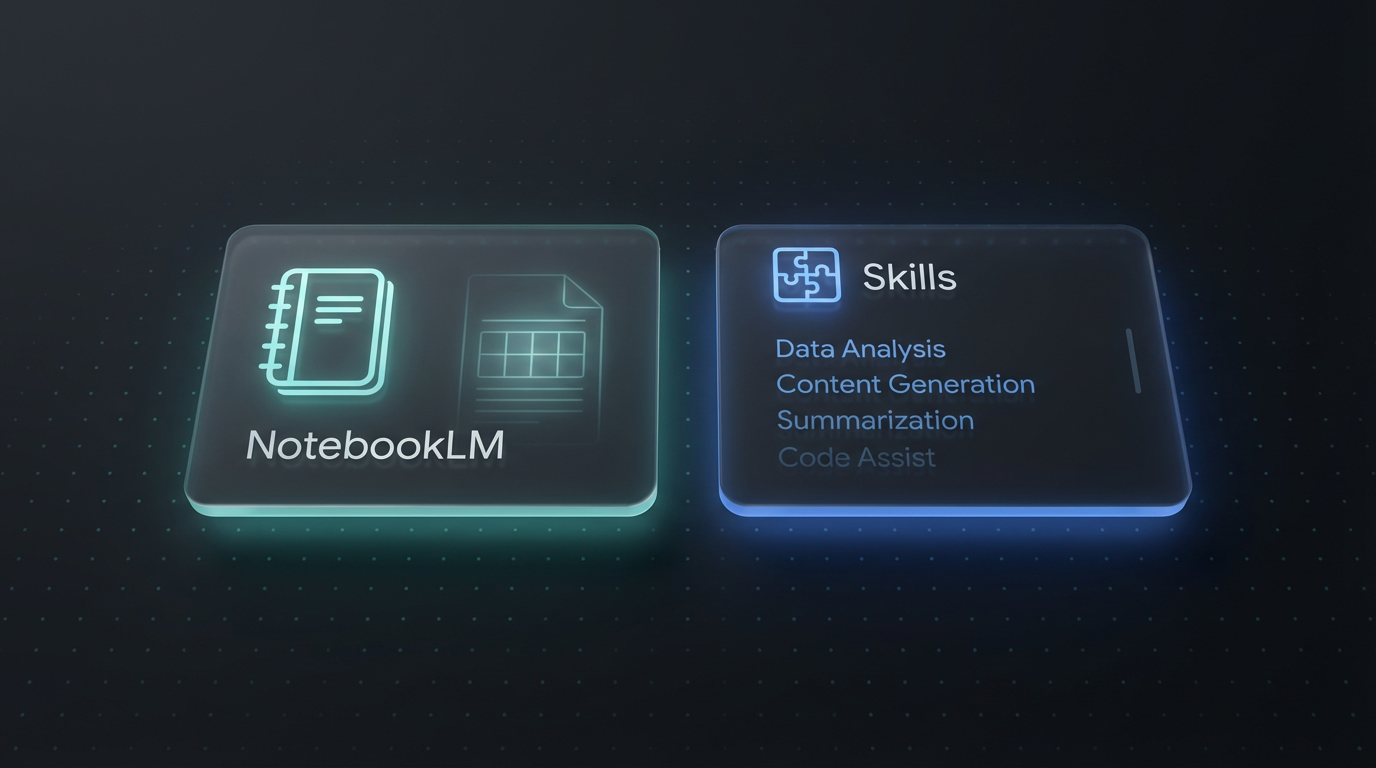
The most immediately useful change is a deeper connection to NotebookLM. Hidden in recent builds is the ability for Business-tier users to access their own NotebookLM notebooks directly from the Gemini front page — eliminating the context switch that currently breaks research workflows.
A pre-built NotebookLM agent has also appeared in the agents section, described as a tool for summarizing and note-taking during research, with apparent access to notebook contents from within Gemini’s conversational interface.
This integration already reached consumer accounts and Workspace Enterprise and Education users in January 2026. Its arrival on the Business tier would close a meaningful feature gap — and for small and mid-sized teams running curated knowledge bases in NotebookLM, having that research surface inside Gemini without switching tools could reshape how daily work actually gets done.
A Skills Library — Including a Tool to Build Your Own
Separately, a Skills tab has appeared inside Gemini for Business builds. The tab is currently non-functional and hidden from standard navigation, but it already displays a populated list of pre-made skills from Google — covering use cases like code review, writing product requirement documents, tone and clarity editing, and resume tailoring.
The entry that signals the most intent is Skill Architect: a meta-skill described as enabling users to build their own custom, domain-specific AI assistants. A new skill creation menu has appeared alongside it, with fields for name, description, and instructions.
The concept of skills isn’t new to Google’s ecosystem. Gemini CLI and Antigravity — Google’s terminal-based and agentic IDE tools respectively — already support installable, specialized instruction sets for developers. Surfacing that capability inside the Business web interface would extend it to a far broader, non-technical audience, and the inclusion of Skill Architect suggests Google wants organizations to build reusable AI workflows without needing an engineering team to do it.
AI Coding Gets a Consolidated Entry Point
A hidden AI Coding button has also appeared in recent builds under a refreshed label. At present it functions more as a directory than a tool — consolidating links to Antigravity and Gemini CLI in one place, along with installation guidance for the command line interface.
The button doesn’t add new capability on its own, but its presence in the Business interface suggests Google is working to surface its developer tooling to a wider Workspace audience, rather than leaving those tools siloed within technical channels.
None of the features above carry a confirmed release date. But the density of progress visible across these builds — NotebookLM parity, a skills layer, no-code customization — suggests Google is moving steadily to position Gemini for Business as a serious enterprise platform, not just a productivity add-on.
Comments
No comments yet. Be the first to share your thoughts.
Sign in or create an account to leave a comment.